OEM PARTS 72476 "ACDelco 22049765 Chevrolet/GMC Front MODEL, SPORTVAN Passenger Side Window Lift Regulator" 97 22049765 ".
" "REGULATOR,FRT S/D WDO" "REGULATOR,FRT S/D WDO" "1982-1995 Chevrolet G10
1982-1995 Chevrolet G20
1982-1996 Chevrolet G30
1993-1996 Chevrolet P30
1982-1995 GMC G1500
1982-1995 GMC G2500
1982-1996 GMC G3500
1993-1996 GMC P3500
1996-1996 GMC Savana 3500"
Showing posts with label Model. Show all posts
Showing posts with label Model. Show all posts
Tuesday, March 3, 2020
Monday, June 17, 2019
Everything You Need To Know To Understand The Porsche 911 Model Range
So, what the heck is the difference between an 'S' and a 'GTS' model?![]() The Bodystyles
The Bodystyles![]()
![]()
![]()
![]()
![]()
Have you ever looked at the entire Porsche 911 lineup? It's like trying to order food off the menu at the world's greatest diner. There are a million good choices, but you still don't know what to get. Porsche currently sells 24 distinct variations of the 911 – we know, we checked. The 911 ranges from around $91,000 on the low end to around $293,000 on the high end, so understanding the lineup can make a big difference. The current 991 generation car will be replaced later this year by an all-new 992 generation, but before it does we wanted to help break down Porsche's dizzying array of 911 models. Here's everything you need to know to decipher today's 911 lineup.
 The Bodystyles
The first thing you should know about the 911 is that it is available in three different body styles: Coupe, Cabriolet, and Targa. Most of the specialty models are only available as coupes, but we'll get to that later on. A coupe is exactly what you would expect - a fixed roof with no hidden tricks. The cabriolet is also pretty self-explanatory with a droptop that retracts without taking up any trunk space (because the trunk is up front).
The Targa is a bit trickier to explain because it has changed from generation to generation. A Targa is a semi-convertible car with a removable roof section with a full-width roll bar behind the seats. Some 911 Targa generations, like the 993, simply had a sliding glass roof instead of a simple removable one. The current 991 generation uses a complicated power system to remove a section of the roof and store it behind the seats. Why get a Targa over a cabriolet? Because it looks cool and is far less common.
Carrera, Carrera S, and Carrera GTSThings get a bit complicated with the Carrera models, which can also be ordered in S or GTS power levels, and as coupes and cabriolets. Each comes standard with rear-wheel drive, and models with a '4' in their name have all-wheel drive. You can also distinguish a 4 model by its wider hips and taillight bar across the rear. RWD and AWD can be combined with all Carrera trim levels, except for the specialty Carrera T (see below). Targas are treated as separate models and can only be ordered with AWD.
The base Carrera is powered by a 3.0-liter twin-turbo flat-six producing 370 horsepower. The Carrera S brings the power up to 420 hp and the GTS to 450 hp. All of these 911s can be ordered with a seven-speed manual transmission or a seven-speed PDK dual-clutch. The manual is more fun, but the PDK is quicker.
Carrera TPorsche loves special lightweight editions, but these are typically reserved for the higher priced models in the 911 range. The Carrera T takes a base Carrera and strips as much weight as possible out of it to create the purest driving experience possible. Power is the same as a base Carrera at 370 hp, but this specialty model certainly feels more special to drive. This is the 911 to buy if you would like to be a bit more unique than the other lawyers in the office but don't want to spend the cash on one of the more expensive models.
Turbo and Turbo SIn the world of 911s, the Turbo has always been the ultimate speed machine. The 911 Turbo has been overlooked in recent years as variants like the GT3 and GT2 RS have taken over the spotlight because of their exclusivity and staggering performance. The Turbo name also makes a bit less sense now that all 911 models, besides the GT3, are turbocharged. All 911 Turbos come with AWD and PDK, making them the quickest off the line.
The base Turbo comes packing 540 hp from a 3.8-liter twin-turbo flat-fix, while the Turbo S produces a meatier 580 hp. Porsche claims 0-60 mph times of 2.9 and 2.8 seconds for the Turbo and Turbo S respectively, but some outlets have tested them at just 2.5 seconds to 60 mph. Despite such savage acceleration, the Turbo is known as one of the quietest and most comfortable 911s, making it the ideal Grand Touring car. Both the Turbo and Turbo S are also available as Cabriolets, which lowers the 0-60 time by a minuscule tenth of a second. Porsche also introduced a Turbo S Exclusive Series, which ups the power to 607 hp.
GT3 ModelsAll 911s are special, but the GT models are really special. These are the most track-focused in the range for owners who like to race on the weekends. The GT3 is the most suited for public roads but is still powered by an awe-inducing 4.0-liter naturally aspirated flat-six with 500 hp. Why use a naturally aspirated engine instead of a turbo one? Because it sounds better, of course. The 991.1 GT3 was only offered with a PDK, but demand from enthusiasts forced Porsche to offer a six-speed manual on the refreshed 991.2. Porsche also sells a Touring Package, which removes the rear wing for a more subtle look.
The GT3 is really a street car for the track, whereas the GT3 RS is more of a track car for the street. Here, the 4.0-liter flat-six produces 520 hp and additional weight is taken out. It is also PDK-only to keep it as fast as possible. The GT3 RS can also be ordered with a more extreme Weissach package that makes it even lighter. Porsche is also rumored to be working on a new Speedster model, which will be based on a GT3 for the first time in the specialty model's history.
GT2 RSThe 911 GT2 started off as a hardcore, RWD version of the Turbo. The current GT2 RS is the ultimate 911, powered by a 3.8-liter twin-turbo flat-six producing 700 hp. Think of the GT2 RS as the best of the GT3 RS and Turbo mixed into one: a savage creation that managed to lap the Nurburgring in just 6 minutes 47 seconds (the quickest time ever for a rear-wheel-drive production car at the time). The GT2 RS is the most expensive 911 with a $293,000 starting price, but like most modern Porsche 911 GTs, the price has already gone up on the second-hand market due to high demand.


Wednesday, June 5, 2019
Everything You Need To Know To Understand The Porsche 911 Model Range
So, what the heck is the difference between an 'S' and a 'GTS' model?![]() The Bodystyles
The Bodystyles![]()
![]()
![]()
![]()
![]()
Have you ever looked at the entire Porsche 911 lineup? It's like trying to order food off the menu at the world's greatest diner. There are a million good choices, but you still don't know what to get. Porsche currently sells 24 distinct variations of the 911 – we know, we checked. The 911 ranges from around $91,000 on the low end to around $293,000 on the high end, so understanding the lineup can make a big difference. The current 991 generation car will be replaced later this year by an all-new 992 generation, but before it does we wanted to help break down Porsche's dizzying array of 911 models. Here's everything you need to know to decipher today's 911 lineup.
The BodystylesThe first thing you should know about the 911 is that it is available in three different body styles: Coupe, Cabriolet, and Targa. Most of the specialty models are only available as coupes, but we'll get to that later on. A coupe is exactly what you would expect - a fixed roof with no hidden tricks. The cabriolet is also pretty self-explanatory with a droptop that retracts without taking up any trunk space (because the trunk is up front).
The Targa is a bit trickier to explain because it has changed from generation to generation. A Targa is a semi-convertible car with a removable roof section with a full-width roll bar behind the seats. Some 911 Targa generations, like the 993, simply had a sliding glass roof instead of a simple removable one. The current 991 generation uses a complicated power system to remove a section of the roof and store it behind the seats. Why get a Targa over a cabriolet? Because it looks cool and is far less common.
Carrera, Carrera S, and Carrera GTSThings get a bit complicated with the Carrera models, which can also be ordered in S or GTS power levels, and as coupes and cabriolets. Each comes standard with rear-wheel drive, and models with a '4' in their name have all-wheel drive. You can also distinguish a 4 model by its wider hips and taillight bar across the rear. RWD and AWD can be combined with all Carrera trim levels, except for the specialty Carrera T (see below). Targas are treated as separate models and can only be ordered with AWD.
The base Carrera is powered by a 3.0-liter twin-turbo flat-six producing 370 horsepower. The Carrera S brings the power up to 420 hp and the GTS to 450 hp. All of these 911s can be ordered with a seven-speed manual transmission or a seven-speed PDK dual-clutch. The manual is more fun, but the PDK is quicker.
Carrera TPorsche loves special lightweight editions, but these are typically reserved for the higher priced models in the 911 range. The Carrera T takes a base Carrera and strips as much weight as possible out of it to create the purest driving experience possible. Power is the same as a base Carrera at 370 hp, but this specialty model certainly feels more special to drive. This is the 911 to buy if you would like to be a bit more unique than the other lawyers in the office but don't want to spend the cash on one of the more expensive models.
Turbo and Turbo SIn the world of 911s, the Turbo has always been the ultimate speed machine. The 911 Turbo has been overlooked in recent years as variants like the GT3 and GT2 RS have taken over the spotlight because of their exclusivity and staggering performance. The Turbo name also makes a bit less sense now that all 911 models, besides the GT3, are turbocharged. All 911 Turbos come with AWD and PDK, making them the quickest off the line.
The base Turbo comes packing 540 hp from a 3.8-liter twin-turbo flat-fix, while the Turbo S produces a meatier 580 hp. Porsche claims 0-60 mph times of 2.9 and 2.8 seconds for the Turbo and Turbo S respectively, but some outlets have tested them at just 2.5 seconds to 60 mph. Despite such savage acceleration, the Turbo is known as one of the quietest and most comfortable 911s, making it the ideal Grand Touring car. Both the Turbo and Turbo S are also available as Cabriolets, which lowers the 0-60 time by a minuscule tenth of a second. Porsche also introduced a Turbo S Exclusive Series, which ups the power to 607 hp.
GT3 ModelsAll 911s are special, but the GT models are really special. These are the most track-focused in the range for owners who like to race on the weekends. The GT3 is the most suited for public roads but is still powered by an awe-inducing 4.0-liter naturally aspirated flat-six with 500 hp. Why use a naturally aspirated engine instead of a turbo one? Because it sounds better, of course. The 991.1 GT3 was only offered with a PDK, but demand from enthusiasts forced Porsche to offer a six-speed manual on the refreshed 991.2. Porsche also sells a Touring Package, which removes the rear wing for a more subtle look.
The GT3 is really a street car for the track, whereas the GT3 RS is more of a track car for the street. Here, the 4.0-liter flat-six produces 520 hp and additional weight is taken out. It is also PDK-only to keep it as fast as possible. The GT3 RS can also be ordered with a more extreme Weissach package that makes it even lighter. Porsche is also rumored to be working on a new Speedster model, which will be based on a GT3 for the first time in the specialty model's history.
GT2 RSThe 911 GT2 started off as a hardcore, RWD version of the Turbo. The current GT2 RS is the ultimate 911, powered by a 3.8-liter twin-turbo flat-six producing 700 hp. Think of the GT2 RS as the best of the GT3 RS and Turbo mixed into one: a savage creation that managed to lap the Nurburgring in just 6 minutes 47 seconds (the quickest time ever for a rear-wheel-drive production car at the time). The GT2 RS is the most expensive 911 with a $293,000 starting price, but like most modern Porsche 911 GTs, the price has already gone up on the second-hand market due to high demand.
Thursday, May 30, 2019
Porsche Mission E Will Destroy The Tesla Model S At The Track
The Tesla may dominate at the drag strip, but the Porsche will own lap times.![]()
![]()
![]()
![]()
![]()
![]()
![]()
As development continues on the upcoming production version of the all-electric Porsche Mission E concept, we know this so far: there are separate motors for the front and rear axles, and there’ll be a combined output of over 600 hp, 0-60 mph time of less than 3.5 seconds and the sprint to 124 mph will be in under 12 seconds. Do a quick comparison and you’ll see the Tesla Model S is faster in a straight line, meaning a drag race. On track, however, it’s a different story.

Car and Driver spoke with Joachim Kramer, Porsche’s director of power electronic for the Mission E, who not only confirmed the Mission E is being developed for optimal track day performance, but also that “The quick-charge cooling demand on the system is not higher than the demand when we go on a racetrack. That’s our development goal: to perform on the Nurburgring and other racetracks.” This will specifically be made possible thanks in part to a single liquid-cooling system designed regulate control and regulate temperatures. For example, the battery itself will not exceed 185 degrees Fahrenheit, but the motor itself will work just fine at far higher temperatures.
Even the air-conditioning compressor plays a part in regulating and cooling the systems during fast driving and even fast charging. In other words, Porsche understands that waiting several minutes for the battery to cool off in between track runs won’t be acceptable for many buyers. What’s the point of a track day if one is constantly being interrupted by their EV’s battery needing some cool off time? Porsche has clearly done its homework and this technological advancement will serve it well especially once its Formula E racing team gets into action next year.


Tuesday, April 9, 2019
Everything You Need To Know To Understand The Porsche 911 Model Range
So, what the heck is the difference between an 'S' and a 'GTS' model?![]() The Bodystyles
The Bodystyles![]()
![]()
![]()
![]()
![]()
Have you ever looked at the entire Porsche 911 lineup? It's like trying to order food off the menu at the world's greatest diner. There are a million good choices, but you still don't know what to get. Porsche currently sells 24 distinct variations of the 911 – we know, we checked. The 911 ranges from around $91,000 on the low end to around $293,000 on the high end, so understanding the lineup can make a big difference. The current 991 generation car will be replaced later this year by an all-new 992 generation, but before it does we wanted to help break down Porsche's dizzying array of 911 models. Here's everything you need to know to decipher today's 911 lineup.
The BodystylesThe first thing you should know about the 911 is that it is available in three different body styles: Coupe, Cabriolet, and Targa. Most of the specialty models are only available as coupes, but we'll get to that later on. A coupe is exactly what you would expect - a fixed roof with no hidden tricks. The cabriolet is also pretty self-explanatory with a droptop that retracts without taking up any trunk space (because the trunk is up front).
The Targa is a bit trickier to explain because it has changed from generation to generation. A Targa is a semi-convertible car with a removable roof section with a full-width roll bar behind the seats. Some 911 Targa generations, like the 993, simply had a sliding glass roof instead of a simple removable one. The current 991 generation uses a complicated power system to remove a section of the roof and store it behind the seats. Why get a Targa over a cabriolet? Because it looks cool and is far less common.
Carrera, Carrera S, and Carrera GTSThings get a bit complicated with the Carrera models, which can also be ordered in S or GTS power levels, and as coupes and cabriolets. Each comes standard with rear-wheel drive, and models with a '4' in their name have all-wheel drive. You can also distinguish a 4 model by its wider hips and taillight bar across the rear. RWD and AWD can be combined with all Carrera trim levels, except for the specialty Carrera T (see below). Targas are treated as separate models and can only be ordered with AWD.
The base Carrera is powered by a 3.0-liter twin-turbo flat-six producing 370 horsepower. The Carrera S brings the power up to 420 hp and the GTS to 450 hp. All of these 911s can be ordered with a seven-speed manual transmission or a seven-speed PDK dual-clutch. The manual is more fun, but the PDK is quicker.
Carrera TPorsche loves special lightweight editions, but these are typically reserved for the higher priced models in the 911 range. The Carrera T takes a base Carrera and strips as much weight as possible out of it to create the purest driving experience possible. Power is the same as a base Carrera at 370 hp, but this specialty model certainly feels more special to drive. This is the 911 to buy if you would like to be a bit more unique than the other lawyers in the office but don't want to spend the cash on one of the more expensive models.
Turbo and Turbo SIn the world of 911s, the Turbo has always been the ultimate speed machine. The 911 Turbo has been overlooked in recent years as variants like the GT3 and GT2 RS have taken over the spotlight because of their exclusivity and staggering performance. The Turbo name also makes a bit less sense now that all 911 models, besides the GT3, are turbocharged. All 911 Turbos come with AWD and PDK, making them the quickest off the line.
The base Turbo comes packing 540 hp from a 3.8-liter twin-turbo flat-fix, while the Turbo S produces a meatier 580 hp. Porsche claims 0-60 mph times of 2.9 and 2.8 seconds for the Turbo and Turbo S respectively, but some outlets have tested them at just 2.5 seconds to 60 mph. Despite such savage acceleration, the Turbo is known as one of the quietest and most comfortable 911s, making it the ideal Grand Touring car. Both the Turbo and Turbo S are also available as Cabriolets, which lowers the 0-60 time by a minuscule tenth of a second. Porsche also introduced a Turbo S Exclusive Series, which ups the power to 607 hp.
GT3 ModelsAll 911s are special, but the GT models are really special. These are the most track-focused in the range for owners who like to race on the weekends. The GT3 is the most suited for public roads but is still powered by an awe-inducing 4.0-liter naturally aspirated flat-six with 500 hp. Why use a naturally aspirated engine instead of a turbo one? Because it sounds better, of course. The 991.1 GT3 was only offered with a PDK, but demand from enthusiasts forced Porsche to offer a six-speed manual on the refreshed 991.2. Porsche also sells a Touring Package, which removes the rear wing for a more subtle look.
The GT3 is really a street car for the track, whereas the GT3 RS is more of a track car for the street. Here, the 4.0-liter flat-six produces 520 hp and additional weight is taken out. It is also PDK-only to keep it as fast as possible. The GT3 RS can also be ordered with a more extreme Weissach package that makes it even lighter. Porsche is also rumored to be working on a new Speedster model, which will be based on a GT3 for the first time in the specialty model's history.
GT2 RSThe 911 GT2 started off as a hardcore, RWD version of the Turbo. The current GT2 RS is the ultimate 911, powered by a 3.8-liter twin-turbo flat-six producing 700 hp. Think of the GT2 RS as the best of the GT3 RS and Turbo mixed into one: a savage creation that managed to lap the Nurburgring in just 6 minutes 47 seconds (the quickest time ever for a rear-wheel-drive production car at the time). The GT2 RS is the most expensive 911 with a $293,000 starting price, but like most modern Porsche 911 GTs, the price has already gone up on the second-hand market due to high demand.
Sunday, March 17, 2019
Everything You Need To Know To Understand The Porsche 911 Model Range
So, what the heck is the difference between an 'S' and a 'GTS' model?![]() The Bodystyles
The Bodystyles![]()
![]()
![]()
![]()
![]()
Have you ever looked at the entire Porsche 911 lineup? It's like trying to order food off the menu at the world's greatest diner. There are a million good choices, but you still don't know what to get. Porsche currently sells 24 distinct variations of the 911 – we know, we checked. The 911 ranges from around $91,000 on the low end to around $293,000 on the high end, so understanding the lineup can make a big difference. The current 991 generation car will be replaced later this year by an all-new 992 generation, but before it does we wanted to help break down Porsche's dizzying array of 911 models. Here's everything you need to know to decipher today's 911 lineup.
The BodystylesThe first thing you should know about the 911 is that it is available in three different body styles: Coupe, Cabriolet, and Targa. Most of the specialty models are only available as coupes, but we'll get to that later on. A coupe is exactly what you would expect - a fixed roof with no hidden tricks. The cabriolet is also pretty self-explanatory with a droptop that retracts without taking up any trunk space (because the trunk is up front).
The Targa is a bit trickier to explain because it has changed from generation to generation. A Targa is a semi-convertible car with a removable roof section with a full-width roll bar behind the seats. Some 911 Targa generations, like the 993, simply had a sliding glass roof instead of a simple removable one. The current 991 generation uses a complicated power system to remove a section of the roof and store it behind the seats. Why get a Targa over a cabriolet? Because it looks cool and is far less common.
Carrera, Carrera S, and Carrera GTSThings get a bit complicated with the Carrera models, which can also be ordered in S or GTS power levels, and as coupes and cabriolets. Each comes standard with rear-wheel drive, and models with a '4' in their name have all-wheel drive. You can also distinguish a 4 model by its wider hips and taillight bar across the rear. RWD and AWD can be combined with all Carrera trim levels, except for the specialty Carrera T (see below). Targas are treated as separate models and can only be ordered with AWD.
The base Carrera is powered by a 3.0-liter twin-turbo flat-six producing 370 horsepower. The Carrera S brings the power up to 420 hp and the GTS to 450 hp. All of these 911s can be ordered with a seven-speed manual transmission or a seven-speed PDK dual-clutch. The manual is more fun, but the PDK is quicker.
Carrera TPorsche loves special lightweight editions, but these are typically reserved for the higher priced models in the 911 range. The Carrera T takes a base Carrera and strips as much weight as possible out of it to create the purest driving experience possible. Power is the same as a base Carrera at 370 hp, but this specialty model certainly feels more special to drive. This is the 911 to buy if you would like to be a bit more unique than the other lawyers in the office but don't want to spend the cash on one of the more expensive models.
Turbo and Turbo SIn the world of 911s, the Turbo has always been the ultimate speed machine. The 911 Turbo has been overlooked in recent years as variants like the GT3 and GT2 RS have taken over the spotlight because of their exclusivity and staggering performance. The Turbo name also makes a bit less sense now that all 911 models, besides the GT3, are turbocharged. All 911 Turbos come with AWD and PDK, making them the quickest off the line.
The base Turbo comes packing 540 hp from a 3.8-liter twin-turbo flat-fix, while the Turbo S produces a meatier 580 hp. Porsche claims 0-60 mph times of 2.9 and 2.8 seconds for the Turbo and Turbo S respectively, but some outlets have tested them at just 2.5 seconds to 60 mph. Despite such savage acceleration, the Turbo is known as one of the quietest and most comfortable 911s, making it the ideal Grand Touring car. Both the Turbo and Turbo S are also available as Cabriolets, which lowers the 0-60 time by a minuscule tenth of a second. Porsche also introduced a Turbo S Exclusive Series, which ups the power to 607 hp.
GT3 ModelsAll 911s are special, but the GT models are really special. These are the most track-focused in the range for owners who like to race on the weekends. The GT3 is the most suited for public roads but is still powered by an awe-inducing 4.0-liter naturally aspirated flat-six with 500 hp. Why use a naturally aspirated engine instead of a turbo one? Because it sounds better, of course. The 991.1 GT3 was only offered with a PDK, but demand from enthusiasts forced Porsche to offer a six-speed manual on the refreshed 991.2. Porsche also sells a Touring Package, which removes the rear wing for a more subtle look.
The GT3 is really a street car for the track, whereas the GT3 RS is more of a track car for the street. Here, the 4.0-liter flat-six produces 520 hp and additional weight is taken out. It is also PDK-only to keep it as fast as possible. The GT3 RS can also be ordered with a more extreme Weissach package that makes it even lighter. Porsche is also rumored to be working on a new Speedster model, which will be based on a GT3 for the first time in the specialty model's history.
GT2 RSThe 911 GT2 started off as a hardcore, RWD version of the Turbo. The current GT2 RS is the ultimate 911, powered by a 3.8-liter twin-turbo flat-six producing 700 hp. Think of the GT2 RS as the best of the GT3 RS and Turbo mixed into one: a savage creation that managed to lap the Nurburgring in just 6 minutes 47 seconds (the quickest time ever for a rear-wheel-drive production car at the time). The GT2 RS is the most expensive 911 with a $293,000 starting price, but like most modern Porsche 911 GTs, the price has already gone up on the second-hand market due to high demand.
Thursday, January 17, 2019
The 2015 Volvo XC60 – A Two Model Comparison
What’s Best: New Drive-E powertrains across the Volvo lineup promise better fuel efficiencies and reduced emissions without any sacrifice in power.
What’s Worst: Unfortunately, the new Drive-E engines are only available in FWD as Volvo makes the transition this year but, by 2016, the new four-cylinder powerplants and eight-speed transmissions should be accessible throughout the XC60 lineup.
What’s Interesting: The fact that Volvo is basing it entire powertrain philosophy on 2.0-litre four-cylinder architecture.
“I think this test should set a good base line for a comparison with one of our newest models,” Kyle from Volvo was telling me as I turned in the keys to an XC60 earlier this spring.
There was just one problem with his supposition.
You see, I already liked the XC60 just fine, exactly the way it was.
The XC60 first debuted in North America with a 2010 model.
It’s probably not unfair to rate the XC60 as a bit player in our Canadian market, ranked next to competitors like the Audi Q5 and BMW X3.
But as a gateway to Volvo’s compact-to-full-sized SUV/crossover lineup, it has quickly gained traction to become their best-selling vehicle, both here and in other markets, recently surpassing the global milestone mark of 500,000 sales since inception.

Last year, the XC60 was changed inside and out.
A revised, sleeker exterior featured new components from the “A” pillar forward, especially a wider grille to emphasize the design’s horizontal dimensions. Cornering lights were added and new DRL LED lamps moved to the front corners.
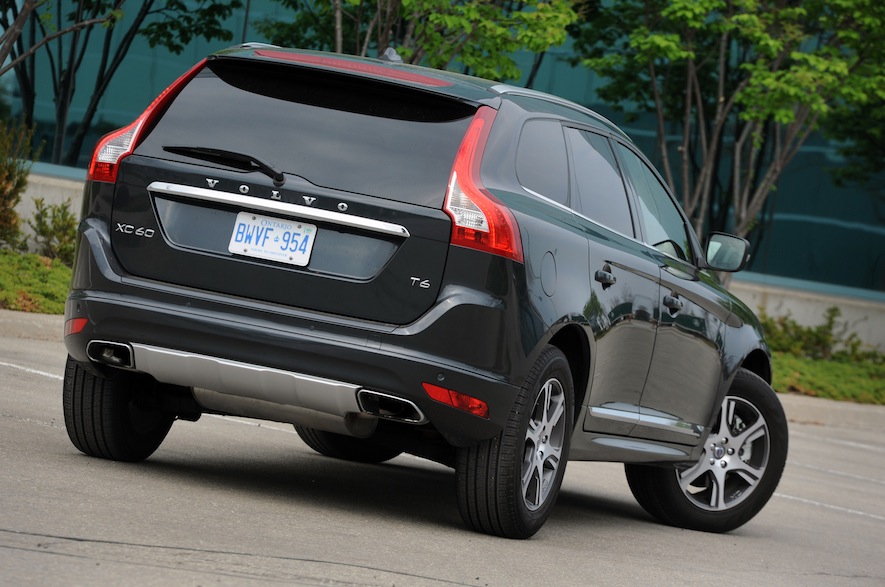
In back, exhaust outlets were incorporated into a new rear fascia and all the black trim cladding along the bottom of the car was removed in favour of a classier, body-coloured look and smoother profile.
Inside, Volvo added new seats, new paddle shifters, an available heated steering wheel, a new Sensus Connect infotainment system, a new Adaptive Digital display with TFT screens instead of the old analogue gauges and a host of electronic upgrades for the already impressive slate of Volvo’s safety technologies.

That mid-cycle refresh went a long way to enhance the appeal of the XC60’s uniquely Scandinavian take on entry-lux crossover accommodation but now, for 2015 and beyond, Volvo is addressing its powertrain lineup.
In fact, Volvo is gambling globally on a selection of new Drive-E engines, all of them based on 2.0-litre, four-cylinder, direct injection architecture. New diesel- (D) or gasoline-powered (T) versions feature a variety of versions with ascending power ratings spread across the company’s entire vehicle lineup.
There are no current plans for an XC60 diesel model here in Canada, or for a hybrid version although the transversely mounted Drive-E engines were designed to be adaptable for future hybrid applications. Indeed, a 2016 plug-in hybrid XC90 T8 is already in the works.
RELATED: Control Your Volvo Car From Your Apple Watch
Because this is a transition year for the changeover to Drive-E powertrains, the new four-cylinder motors will only be available in a front-wheel-drive (FWD) configuration on XC60 models. A two-engine Drive-E choice is available here in Canada – a T5 240 hp turbocharged engine and a T6 302 hp version that adds supercharging to the turbocharging system.
My comparison test started earlier this year with an existing 2015 XC60 T6 AWD ($53,650) model in top-of-the-line Platinum Trim, and in Ice White with a Graphite Leather interior. Volvo’s always seem to shimmer best in silver, but they are almost equally elegant in white, complementing the sleeker, streamlined shape courtesy of last year’s modifications.

Under the hood, that first 2015 XC60 test vehicle harnessed a 3.0-litre turbocharged engine boasting 300 hp and 325 lb/ft of torque. The inline-six turbo engine was mated to a six-speed Geartronic automatic with Advanced Quick Shift.
There’s little to complain about when it comes to the power or demeanor of this six-banger/six-speed combo but Volvo has always been quick to set the bar higher when it comes to performance, fuel economy and emissions.

This engine has been criticized in the past for a not very competitive 13.5/9.7L/100km (city/hwy), verified by my real world results, averaging out to 13.3L/100km (comb).
A few weeks later, I found myself in the seat of my second XC60 test ride; a just released 2015 XC60 T6 Drive-E FWD ($51,950).
RELATED: Volvo XC90 SUV heralds brand’s renewal
It was also tricked out in Platinum trim but was more anonymously discreet in Saville Grey, setting a monochromatic balance with the Graphite Leather interior.

More importantly, it harnessed the new Drive-E 2.0-litre turbocharged and supercharged four-cylinder engine with 302 hp and 295 lb/ft of torque. Those numbers come pretty darn close to the turbo six-cylinder power ratings.

This new inline-four engine is also mated to a more modern eight-speed Geartronic automatic with Start/Stop technology and an Adaptive Shift system. This smaller but almost equally powerful engine combines with the more efficient eight-speed tranny for an improved fuel economy rating of 10.9/7.8L/100km (city/hwy). My personal averages, again, based on a real world mix of driving conditions, worked out to 9.8L/100km (comb). Quite a difference when compared to six-cylinder efficiencies.
Those numbers will be impacted somewhat in future should Drive-E powertrains be harnessed in AWD models, which tend to add a 100 kg or so to the overall curb weight. Sort of like having your fat aunt Agnes permanently ensconced in the back seat.
But the new Drive-E fuel economy numbers are pretty impressive in their own right, especially when you consider that both engines make that power on regular octane fuel.
And, although petrol penny-pinching is probably not foremost in the minds of near-luxury customers who pay in the neighbourhood of $50K for their cars or crossovers, it still marks a significant technological evolution in the efficiencies of Volvo’s powertrain plans and aspirations.
Weigh in all the other factors – the unique styling and individualistic cachet of the Volvo brand, the legendary reputation for safety and technological innovation and a long list of luxuries and amenities even in this, Volvo’s entry-level crossover, and the XC60 stands out as a competitive alternative for entry-luxury customers looking for something that stands out as being just a little different from the mass of more common competitors in this segment.
BODY STYLE: Entry-luxury, compact to midsize CUV
DRIVE METHOD: Front-engine, front-wheel-drive (FWD) or all-wheel-drive (AWD)
ENGINE: 2015 XC60 T6 AWD – 3.0-litre turbocharged inline-six (300 hp, 325 lb/ft); 2015 XC60 T6 Drive-E FWD – 2.0-litre Drive-E turbocharged and supercharged four-cylinder engine (302 hp, 295 lb/ft).
CARGO: 872 litres, 1.909 litres with second row seats folded
FUEL ECONOMY: 2015 XC60 T6 AWD – 3.0-litre 13.5/9.7L/100km (city/hwy); 2015 XC60 T6 Drive-E FWD – 2.0-litre 10.9/7.8L/100km (city/hwy)
PRICES: 2015 XC60 T6 AWD Platinum Trim MSRP $53,650. As tested $58,500; 2015 XC60 T6 Drive-E FWD Platinum Trim MSRP $51,950. As tested $57,600.

RELATED: Volvo Cars Drive-E T5 Wins Ward’s 10 Best Engines Of 2015

Monday, January 14, 2019
Porsche Says 911 Will Be The Last Model To Ditch Its Gas Engine
An all-electric 911 is still a distant thought.![]()
![]()
![]()
![]()
![]()
![]()
![]()
![]()
We can still remember the outrage that erupted when Porsche switched over from the air-cooled 993 generation 911 to the water-cooled 996 generation. So what kind of angry mob can we expect when Porsche does something crazy like introduce a 911 hybrid, or worse, an all-electric 911? Fortunately, Porsche has been telling us for a while now that an all-electric 911 is still at least 10 years away.
At the Silverstone 6-Hour race, Dr. Frank-Steffen Walliser, vice president of Motorsport and GT cars for Porsche, confirmed to Drive that electric Porsche sports cars are coming, though they may not wear a 911 badge.

Walliser confirmed that electric GT Series cars are coming soon, even adding that “I would say it’s less” than 10 years. Porsche is gearing up to build electric cars such as the upcoming Taycan, but the company wants to make sure that 911 remains gas-powered for as long as possible. “I would say the 911 would be the last car that we would make with an electric drivetrain,” Walliser said. "We could say the last sports car will be a Porsche, I would even say the last Porsche ever built with a combustion engine is a GT3. Six-speed manual. Naturally-aspirated.”

Walliser was also asked about the prospect of a mid-engine 911 and even confirmed that there has been customer demand. Some customers have even asked for a road-going version of the 911 RSR race car, but Walliser said the company wouldn't want to ruin the tradition of the rear engine. “A lot of the character of the 911 is the rear-engine, and we are sensitive. In racing we have more freedom, for the streetcar it’s tricky.” Do you hear that 911 enthusiasts? The car is staying exactly how you like it - gas-powered and rear-engined, at least for now.


Friday, December 7, 2018
Here's Proof Porsche Taycan Is Being Benchmarked Against Tesla Model S
Just watch this video.
![]()
Last March, when the Porsche Taycan was still being referred to as the Mission E, Porsche CEO Oliver Blume stated that “Tesla is not a benchmark for us.” Well, that’s not exactly accurate. How do we know? Here’s proof, thanks to the folks at Taycan Forum. This recently filmed spy video shows not one, but two Taycan advanced prototypes testing with a Tesla Model S P85D on Italy’s famed Stelvio Pass. No benchmarking, right Oliver?
Can’t say we’re in the least bit surprised, but why did Blume even state that in the first place? The most likely answer is that Porsche wants the Taycan to be seen as a Porsche first and an EV second.

Porsche also probably doesn’t want to admit it’s being forced to benchmark against what many consider to be a California-based startup that has no business being in the car business. Tesla doesn’t play by the so-called industry rules and established brands don’t like that.
Also interesting to point out here is that the Model S in question is not the most powerful trim you can buy today. That would be the P100D, which can accelerate from 0-60 mph in 2.5 seconds and has a 315-mile range per charge. The P85D had a 253-mile range a 3.2-second sprint to 60. Shouldn’t Porsche be benchmarking the top trim Model S? It surely is, but these Taycan test mules could themselves be lower trims.
Set to go on sale for 2020, the Taycan will be the first all-electric Porsche; more will come soon. But even if the Taycan initially outperforms the Model S in every major category for all trims, we need to take another factor into account: a major Model S update is planned for some time in 2019 or 2020.
Early reports suggest this update will mainly focus on the interior, but we wouldn’t be surprised to see exterior styling changes as well. Will Porsche’s benchmarking that’s not really benchmarking ultimately pay off? We’ll find out next year.
View the original article here
https://carbuzz.com/rss/cars/porsche/718-cayman
Subscribe to:
Posts (Atom)