Showing posts with label Porsche. Show all posts

Tuesday, June 18, 2019

This $13 Million Porsche Superyacht Is A Bargain For The Super Rich

For those in need of downsizing from their 60-meter yachts.

Meet the Dynamiq GTT 115 Hybrid, a 35-meter all-aluminum superyacht dripping with Porsche DNA and the latest in a line of ultra-exclusive vessels inspired by supercars. "Taking the spirit of high-performance sportscar styling to the high seas, the Dynamiq GTT 115 is designed to appeal to car lovers and forward-thinking yacht owners who appreciate the advantages of speed, style and our philosophy of intelligent performance," says Roland Heiler, Managing Director at Porsche Design Group.

Standing for 'Grand Turismo Transatlantic,' the GTT 115 features a round bilge aluminum hull and comes powered by a pair of 1213 kW MAN engines and the latest Fortjes 5000 pods, giving it a max speed of 21 knots. With a 1.45-meter shallow draft, the superyacht is ideal for the Mediterranean, Caribbean or Southeast Asia, but it is capable of crossing the Atlantic with a range of 3,400 nm (around 3,900 miles). Available in Porsche Carrara white, Rhodium Silver, Chalk or Monte-Carlo Blue, the superyacht boasts signature Porsche elements such as the Pepita houndstooth deck cushions borrowed from the 911 R, the Targa-style mullions and the design of the red transom echoing the Mission E concept’s single blade rear light.

The interior comes with either three of four luxury cabins finished in Saddle brown and Luxor beige leather, swathes of Sahara Noir marble and carbon-fiber trim. Italian designer Minotti took care of the furniture and decor. Aimed at owners of large, 50-meter yachts looking to downsize, Dynamiq offers an online configurator enabling buyers to customize every aspect of the GTT 115, from paint colors to electronics. Prices start from 11,900,000 Euros (just over $13 million) limited to just seven units with a turnaround time of 15 months. The first GT 115 is available for sale with delivery this September. Its debut is set for the 2017 Monaco Yacht Show.


View the original article here

Monday, June 17, 2019

Everything You Need To Know To Understand The Porsche 911 Model Range

So, what the heck is the difference between an 'S' and a 'GTS' model?

Have you ever looked at the entire Porsche 911 lineup? It's like trying to order food off the menu at the world's greatest diner. There are a million good choices, but you still don't know what to get. Porsche currently sells 24 distinct variations of the 911 – we know, we checked. The 911 ranges from around $91,000 on the low end to around $293,000 on the high end, so understanding the lineup can make a big difference. The current 991 generation car will be replaced later this year by an all-new 992 generation, but before it does we wanted to help break down Porsche's dizzying array of 911 models. Here's everything you need to know to decipher today's 911 lineup.

The Bodystyles

The first thing you should know about the 911 is that it is available in three different body styles: Coupe, Cabriolet, and Targa. Most of the specialty models are only available as coupes, but we'll get to that later on. A coupe is exactly what you would expect - a fixed roof with no hidden tricks. The cabriolet is also pretty self-explanatory with a droptop that retracts without taking up any trunk space (because the trunk is up front).

The Targa is a bit trickier to explain because it has changed from generation to generation. A Targa is a semi-convertible car with a removable roof section with a full-width roll bar behind the seats. Some 911 Targa generations, like the 993, simply had a sliding glass roof instead of a simple removable one. The current 991 generation uses a complicated power system to remove a section of the roof and store it behind the seats. Why get a Targa over a cabriolet? Because it looks cool and is far less common.

Carrera, Carrera S, and Carrera GTS

Things get a bit complicated with the Carrera models, which can also be ordered in S or GTS power levels, and as coupes and cabriolets. Each comes standard with rear-wheel drive, and models with a '4' in their name have all-wheel drive. You can also distinguish a 4 model by its wider hips and taillight bar across the rear. RWD and AWD can be combined with all Carrera trim levels, except for the specialty Carrera T (see below). Targas are treated as separate models and can only be ordered with AWD.

The base Carrera is powered by a 3.0-liter twin-turbo flat-six producing 370 horsepower. The Carrera S brings the power up to 420 hp and the GTS to 450 hp. All of these 911s can be ordered with a seven-speed manual transmission or a seven-speed PDK dual-clutch. The manual is more fun, but the PDK is quicker.

Carrera T

Porsche loves special lightweight editions, but these are typically reserved for the higher priced models in the 911 range. The Carrera T takes a base Carrera and strips as much weight as possible out of it to create the purest driving experience possible. Power is the same as a base Carrera at 370 hp, but this specialty model certainly feels more special to drive. This is the 911 to buy if you would like to be a bit more unique than the other lawyers in the office but don't want to spend the cash on one of the more expensive models.

Turbo and Turbo S

In the world of 911s, the Turbo has always been the ultimate speed machine. The 911 Turbo has been overlooked in recent years as variants like the GT3 and GT2 RS have taken over the spotlight because of their exclusivity and staggering performance. The Turbo name also makes a bit less sense now that all 911 models, besides the GT3, are turbocharged. All 911 Turbos come with AWD and PDK, making them the quickest off the line.

The base Turbo comes packing 540 hp from a 3.8-liter twin-turbo flat-fix, while the Turbo S produces a meatier 580 hp. Porsche claims 0-60 mph times of 2.9 and 2.8 seconds for the Turbo and Turbo S respectively, but some outlets have tested them at just 2.5 seconds to 60 mph. Despite such savage acceleration, the Turbo is known as one of the quietest and most comfortable 911s, making it the ideal Grand Touring car. Both the Turbo and Turbo S are also available as Cabriolets, which lowers the 0-60 time by a minuscule tenth of a second. Porsche also introduced a Turbo S Exclusive Series, which ups the power to 607 hp.

GT3 Models

All 911s are special, but the GT models are really special. These are the most track-focused in the range for owners who like to race on the weekends. The GT3 is the most suited for public roads but is still powered by an awe-inducing 4.0-liter naturally aspirated flat-six with 500 hp. Why use a naturally aspirated engine instead of a turbo one? Because it sounds better, of course. The 991.1 GT3 was only offered with a PDK, but demand from enthusiasts forced Porsche to offer a six-speed manual on the refreshed 991.2. Porsche also sells a Touring Package, which removes the rear wing for a more subtle look.

The GT3 is really a street car for the track, whereas the GT3 RS is more of a track car for the street. Here, the 4.0-liter flat-six produces 520 hp and additional weight is taken out. It is also PDK-only to keep it as fast as possible. The GT3 RS can also be ordered with a more extreme Weissach package that makes it even lighter. Porsche is also rumored to be working on a new Speedster model, which will be based on a GT3 for the first time in the specialty model's history.

GT2 RS

The 911 GT2 started off as a hardcore, RWD version of the Turbo. The current GT2 RS is the ultimate 911, powered by a 3.8-liter twin-turbo flat-six producing 700 hp. Think of the GT2 RS as the best of the GT3 RS and Turbo mixed into one: a savage creation that managed to lap the Nurburgring in just 6 minutes 47 seconds (the quickest time ever for a rear-wheel-drive production car at the time). The GT2 RS is the most expensive 911 with a $293,000 starting price, but like most modern Porsche 911 GTs, the price has already gone up on the second-hand market due to high demand.


View the original article here

Sunday, June 16, 2019

Porsche 911 Targa

The 911 Targa is the glass roof version of the 911 Carrera. Both the 3.6 and 3.8 liter engines are carried over, therefore, performance is nearly identical. But for those who enjoy the looks of the coupe over the cabriolet, the Targa may be your best bet. Although the roof weighs an additional 130 lbs, leave it to the Porsche engineers to compensate for the extra weight by modifying the suspension.

In addition, when the roof is retracted, a small glass deflector that sits above the windshield is raised to aid in aerodynamic stability. A long-time 911 option, the Targa continues to be a popular choice for those who love the panoramic view of the sun and sky.


View the original article here

Porsche Ranks Highest in J.D. Power Initial Quality Study

Porsche logo

Porsche Cars North America, Inc. Logo. (PRNewsFoto/Porsche Cars North America, Inc.)

For the third year in a row, U.S. customers have rated Porsche highest among all automotive nameplates in the 2015 J.D. Power Initial Quality Study.

In addition to the brand taking overall honors, the Porsche 911 ranked highest for the fourth consecutive year in its vehicle segment (Midsize Premium Sporty Car), while Boxster and Cayman swept the first two places in the Compact Premium Sporty Car segment.

PORSCHE 911

In its first year of production, the Porsche Macan was awarded the highest rank in the Compact Premium SUV segment.

The Cayenne and Panamera models achieved third place in their vehicle segments of Midsize Premium SUV and Large Premium Car.

As a result, this is the first time that five Porsche model series have reached the top 3 rankings in their respective segments.

The J.D. Power Initial Quality Study measures the number of problems experienced by U.S. customers during the first 90 days of ownership.

RELATED: Most Popular Technology Trends according to J.D. Power

Initial quality is determined by the number of problems experienced per 100 vehicles with a lower score meaning higher quality.

Porsche scored only 80 points on the problems per 100 scale, compared to the premium industry average of 110. The overall industry average was 112.

RELATED: Porsche Boxster and 911 Carrera Black Edition models

Full Press Release

Follow Wheels.ca on
Facebook
Instagram


View the original article here

Saturday, June 15, 2019

Porsche Has Issued A Microscopic Airbag Recall For Its Newest Models

CarBuzz logo Related Reviews (function(w,d,s,l,i){w[l]=w[l]||[];w[l].push({'gtm.start':new Date().getTime(),event:'gtm.js'});var f=d.getElementsByTagName(s)[0],j=d.createElement(s),dl=l!='dataLayer'?'&l='+l:'';j.async=true;j.src='https://www.googletagmanager.com/gtm.js?id='+i+dl;f.parentNode.insertBefore(j,f);})(window,document,'script','dataLayer','GTM-MJCGS3N');var _comscore = _comscore || [];_comscore.push({ c1: "2", c2: "28140907" });(function() {var s = document.createElement("script"), el = document.getElementsByTagName("script")[0]; s.async = true;s.src = (document.location.protocol == "https:" ? "https://sb" : "http://b") + ".scorecardresearch.com/beacon.js";el.parentNode.insertBefore(s, el);})();Sorry, I could not read the content fromt this page.

View the original article here

Friday, June 14, 2019

The Slantnose Job On This Porsche 930 Has An Odd History

Question is, who did the conversion?

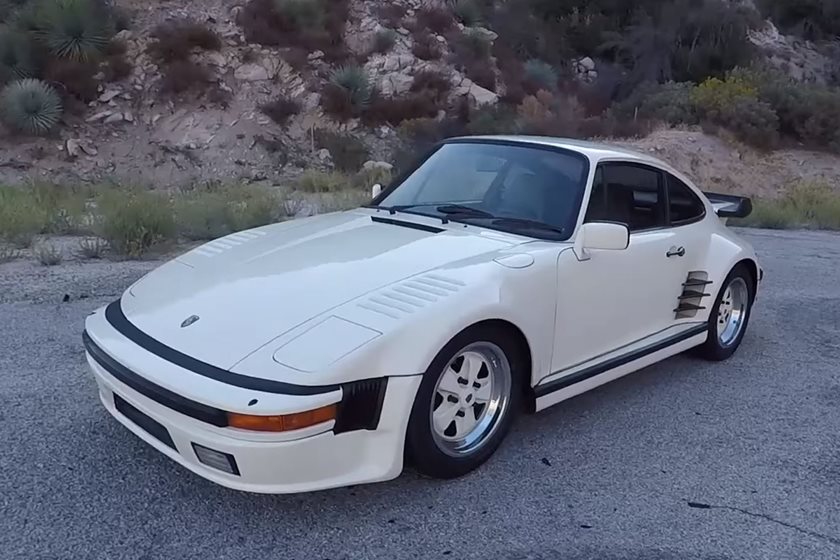
This 1982 Porsche 930 Slantnose, or “Flachbau,” is a very rare treat. Not too many of these were built and this one has just 83,000 original miles. Now, the Slantnose conversion, while done in Germany, may or may not have been done by Porsche itself. Its owner does have a certificate of authenticity and the work is very well done. It’s all metal and no fiber glass. On this latest episode of The Smoking Tire, Matt Farah gets behind the wheel of one of the only Flachbaus registered in California.

In fact, this particular one was originally a European-spec. The US market 930s came powered by a turbocharged 3.0-liter flat-six, but this one has a 3.3-liter with 330 hp. And yes, it’s completely stock save for one small thing: the steering wheel.

The original one is ugly because it’s a four-spoke unit, but it’s fortunately been swapped out in favor of an also Porsche-made three-spoke wheel. Save for that, this Slantnose 930 is exactly the same as it was when it left the Porsche factory some 35 years ago. Needless to say, it’s quite popular with the local Porsche and Cars and Coffee crowd. It’s not every day you see a Slantnose and if the owner ever wanted to sell his car there’d be no shortage of buyers willing to pay serious money.


View the original article here

Wednesday, June 12, 2019

Forget Your Local Mechanic, Porsche Wants To Service Your Classic

Porsche wants to cash in on classic cars.

Vintage Porsche models are extremely collectible and have been skyrocketing in price recently. In fact, classic Porsche models are such a large market, even Porsche itself has decided to build parts to help these cars on the road. More than 70% of all Porsche cars ever built are still on the road, most of which are serviced by independent shops.

While Porsche can certainly brag about how many of its cars are still on the road, it doesn't really do the German automaker any good if they are all being serviced by private mechanics. According to Automotive News, the company will expand its Porsche Classic operations to capture more business from classic car owners.

Porsche Classic currently has 10 dealers in the US, which can repair, maintain, and even perform factory-sanctioned restoration on classic models. While 10 dealers is a nice start, Porsche wants to include more of its 190 stores in the program, though Porsche Cars North America CEO Klaus Zellmer didn't mention exactly how many dealers would be included. "What I can tell you is, I think there needs to be a lot more," Zellmer said. "Strategically speaking, we need to ramp up our game because that's a business field where we can still grow."

Even though Porsche classic only has 10 stores, its business is growing at a rapid 10% per year (the fastest growth of any Porsche business in the US). "The business here in the States is growing at a much higher rate than anything else we do at the moment," Zellmer said. "There's a lot of work that we need to do here in the United States in order to take care of those wonderful pieces of art."

Becoming a Porsche Classic dealer isn't easy. The factory takes into account the age and size of the showroom, the dealer's demographics, the quality of the service technicians, and the amount of volume through the service department. If approved, a Porsche Classic dealer can work on any class Porsche model - any model that has been out of production for 10 years or more.

Porsche Classic currently provides over 52,000 parts to dealers and independent shops to help keep classic models on the road. Over 300 new parts are added each year, and soon, more dealers will be added to ensure these vehicles stay in working order and Porsche keeps rolling in profits.


View the original article here

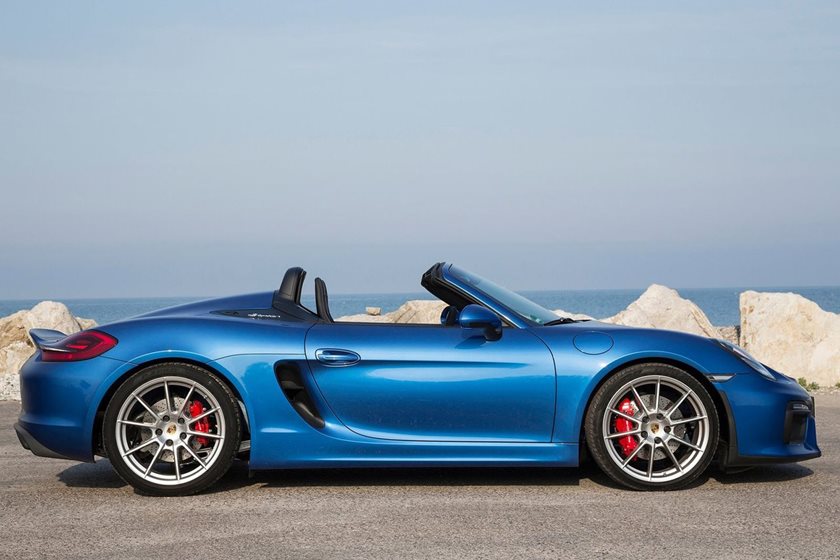
Here Are More Details About The New Porsche 718 Boxster Spyder

Lighter, more powerful, and naturally aspirated.

It’s no longer a secret that Porsche will shoehorn the 911 GT3’s naturally aspirated 4.0-liter flat-six into the upcoming Cayman GT4 and Boxster Spyder. While we still don’t know exactly when either of those mid-engine delights will be revealed (a good guess would be Geneva for at least one), Autocar has managed to gather a few more details about both cars. First off, a six-speed manual will come standard while the seven-speed PDK dual-clutch gearbox will be optional for those wanting to maximize track performance times.

Porsche can’t allow a supposed “lesser model” to outdo the 911 GT3, so that engine will be slightly detuned from 493 hp to around 425 hp. Considering the 718 Boxster is already lighter than the 911, we doubt anyone will complain. Speaking of lightweight, the Spyder especially requires a number of weight-saving methods in order to achieve Porsche’s desired power-to-weight ratio. Problem is, any roadster/convertible weighs more than its coupe counterpart, but Porsche has experience overcoming this. The Boxster Spyder has always been the feather light, end of the generation ultimate variant for a number of years.

As such, the 718 Boxster’s electric folding hardtop is a goner; that mechanism system, impressive as it is, is simply too heavy. Instead, the familiar Spyder “tent top” will be utilized. Convenience features such as air conditioning and a radio will also be absent, though they could be optional. Sound deadening materials will also be removed, and this is actually a smart thing because Spyder buyers will naturally want to hear as much of the open road as possible. A set of Michel Pilot Sport Cup 2 tires will come standard in order for the new Boxster Spyder to be one of the best-handling cars Porsche has ever built. It’ll certainly be the best-handling Boxster so far.

Overall exterior styling, save for the top, will be very similar to the new 718 Cayman GT4. However, the latter will be equipped with a large rear wing because, since it’s a coupe, will be considered even more hardcore.


View the original article here

Tuesday, June 11, 2019

There’s Now A Much Cheaper Way To Own A Porsche 911 R

You only need to assemble 108 pieces.

Remember the limited-edition Porsche 911 R? At one point, it was one of the most sought-after Porsches on the market. Essentially a GT3 with a manual gearbox, it was the driver-focused 911 purists had been dreaming of. Originally, the 911 R came with an asking price of $184,900, but high demand for the 911 R, which had a production run of fewer than 1,000 units, resulted in prices soaring on the used market.

It got to a point where some dealers charged over $1 million for a used 911 R. Thankfully, the launch of the GT3 Touring Package has resulted in used 911 R prices plummeting, but pristine examples are still selling for around $300,000. There is, however, now a cheaper way to own a 911 R – providing you don’t mind it not having an engine and being significantly smaller.

German toy and puzzle maker Ravensburger has collaborated with Porsche to create a 1:18 scale model of the 911 R. But instead of being packaged as a completed model, it’s a 3D puzzle. Comprising of 108 injection-molded plastic pieces, the completed model looks surprisingly authentic when seen alongside the real thing. Sadly, the miniature 911 R doesn't have the real car's naturally-aspirated 4.0-liter flat six that produces 493 horsepower and six-speed manual, but it does have working wheels so you can drive it around your desk while making infantile pretend engine noises.

“It was a challenge to recreate the iconic shape of the Porsche 911 R as accurately and in as much detail as possible”, says Martin Fischer, development engineer at Ravensburger. “That and dividing up the puzzle segments were the most complex steps from a technical point of view.”

Porsche says the 911 R 3D puzzle is “just the starting point for an extensive collaboration” with Ravensburger in the coming years. The puzzle is available to buy on the Porsche Online Shop retailing for 29.99 euros ($35), at the Porsche Museum and at Porsche Leipzig, as well as from the Ravensburger Online Shop and toy shops.


View the original article here

There's No Reason Why A Low-Mileage Porsche 911 R Costs This Much

Other than to just say you drive a 911 R.

Porsche had no clue prices of its 911 R would blow up the way they did a couple of years ago. There were some reports the purists’ 911, basically a more analog version of the pre-facelift 911 GT3 RS, was being sold for nearly $1 million by those anxious to flip them at a serious profit. Needless to say, Porsche did not like seeing this flipping and wanted to find a way to douse the hot dollar flames. The result was the 911 GT3 Touring Package. Same naturally aspirated 4.0-liter flat-six engine. Same six-speed manual transmission. Same body kit.

Only it didn’t have the coveted 911 R badges. Instead of limiting production to just 991 examples, as was the case with the 911 R, the GT3 Touring Pack is widely available. You can pop into your local Porsche dealership right now and buy. one Asking price: around $146,000. The 911 R originally went for about $168,000. But if you just have to have a 911 R, then this low-mileage example just came up for sale on Bring a Trailer. It’s hardly been driven with a mere 87 miles on its odometer, and, as of this writing, the highest bid was $260,000. That’s a difference of $114,000 between an ever so lightly used 2016 911 R and a 2018 911 GT3 Touring pack.

Will the 911 R continue to increase in value, hence justifying this purchase? Perhaps, but now that the GT3 Touring Pack exists, chances are 911 R values have plateaued, more or less. It really boils down to, in this case, how much it’s worth to say “I drive a 911 R” to anyone who asks. Photos courtesy of Bring a Trailer.


View the original article here

Monday, June 10, 2019

Porsche Enthusiasts Are Crying Out For More Lightweight Models

The Weissach package is so popular, it may trickle down to non-RS models.

Porsche created the Weissach package for the 918, offering weight savings of 88 pounds. The package was extremely popular, and the company has decided to bring it to new RS cars such as the GT2 RS and the recently revealed GT3 RS. Speaking to Digital Trends, Andreas Preuninger, the head of Porsche’s GT division, spoke about the popularity of lightweight models and their potential in the future. Porsche developed a Weissach Package for the GT3 RS because the take rate was so high on the GT2 RS.

Preuninger said "Nearly everybody wants this not very inexpensive option. On the 911 GT2 RS, the take rate is 90-percent plus." On the GT3 RS, the package costs $18,000 and sheds around 40 pounds through the use of carbon fiber, lightweight carpeting, and optional magnesium wheels. Porsche fans love the idea of a lighter 911, and the idea could even trickle down to non-RS models. Preuninger said "I think saving weight makes sense in all cars nowadays. A car that is light is always nicer to drive and it uses less gas; this is physics." The company has no immediate plans to offer this option, but "it’s definitely something we could look into" he said.

Unfortunately, Porsche can't just start producing lightweight cars overnight. Preuninger explained "We have to build that up slowly otherwise we can’t supply the parts. I won’t rule out some lightweight package finding its way to other model lines in the future. We have nothing planned yet, we’re very busy; don’t expect to see the Cayenne Weissach next month." In one bit of disappointing news from Porsche, Preuninger confirmed that a manual transmission is unlikely for any RS cars. "There’s not much demand for one. I don’t think we’d have more than a 10-percent take rate," he said. "With the Touring package and the available manual transmission in the normal GT3 we have it sorted in the correct way."


View the original article here