Showing posts with label luxury. Show all posts

Thursday, May 16, 2019

Luxury Car Nameplates We Want Brought Back To Life

Like the BMW 8 Series, we'd like to see these models get revived.

Just like Hollywood, modern automakers can't help but dive into the well of the past to pull out the greatest hits. Why struggle to invent something new when you can dust off Snow White for the thousandth time and tell the story yet again? The industry is about to experience an influx of revived nameplates including the BMW 8 Series, Alfa Romeo GTV, and Toyota Supra. We are happy to see these models make a return, but we wondered what other luxury nameplates deserve to be revived. Here are our eight contenders.

Porsche 928

The Porsche 928 is one of several models rumored to be reintroduced to the Porsche lineup. The original car was a RWD V8 Grand Tourer, which would easily slot above the 911 as a more luxurious option for buyers. We'd love to see Porsche base a new 928 on the Panamera platform, along with its twin-turbo V8 hybrid drivetrain producing 680 horsepower.

Acura RSX

The Acura RSX, also known as the Integra, was one of our favorite cars that Honda ever built. By the end of its life, it offered a 2.4-liter VTEC four-cylinder producing 201 hp in the RSX Type S. The RSX/Integra was sporty to drive, but also packed some of the practicality of a hot hatchback. With the popularity of SUVs and crossovers, it seems unlikely that Acura will bring back a sporty hatchback.

Buick Regal GS

The Buick Regal GS is a nice, comfortable sports sedan, but it doesn't live up to the brand's most badass model: the Grand National. The original Grand National was based on a Regal, but Buick seems reluctant to revive its legendary nameplate. We think a twin-turbo, 400 hp Regal Grand National could pick up where its predecessor left off, for around the $50,000 price range.

Cadillac Eldorado

One of the things that annoys us about Cadillac right now is the company's lack of creativity in the naming department. CT6 sounds like a graphing calculator, and the ATS, CTS, and XTS scheme never made that much sense. We miss names like Eldorado and Coupe DeVille, and wish Cadillac would reincorporate these names back into the lineup. We have seen Cadillac build gorgeous concept cars like the Ciel, all that's left is to build one and give it a name from the company's past.

Lamborghini Espada

Lamborghini is best known for its mid-engine V12 flagships: the Miura, Countach, Diablo, Murcielago, and Aventador. However, the company does have some lesser known models that we'd like to see today. The Espada was a large, front-engine V12 GT car, which could go toe-to-toe with models such as the Aston Martin DB11 and Bentley Continental. Since Volkswagen owns both Bentley and Lamborghini, the German automaker likely doesn't want too much competition between its own brands.

Alfa Romeo Spider

Alfa Romeo currently uses the Spider name on the convertible version of the 4C sport car, but it used to be one of the prettiest and affordable two-seat convertible cars on the market. When Mazda and FCA announced a partnership to build a two-seat roadster based on the Miata, we thought it would be the return of the Alfa Romeo Spider. Instead, we got the slightly disappointing Fiat 124.

Bugatti Atlantic

Bugatti is one of the most fabled brands in the automotive industry, so it seems almost cruel to leave so much of the company's past within the pages of history. We'd love to see the legendary Bugatti Atlantic come back as an ultra-luxurious four-door sedan, based on the Galibier concept from several years ago. Of course, power would come from the Chiron's quad-turbo W16 engine.

Ferrari Daytona

The Ferrari 365 GTB/4, also known as the Daytona, was built from 1968 to 1973. Like most Ferrari models, the Daytona had an official numerical name, but became well-known by its media-given name after the car finished 1-2-3 at the 1967 24 Hours of Daytona. We'd like to see Ferrari bring back nameplates such as Daytona when it builds special one-off models for wealthy customers.


View the original article here

Thursday, April 4, 2019

Luxury 2016 Lincoln MKX to Debut this Summer

Craftsmanship helps define the overall quality of any luxury product.

Customers of the Lincoln MKX, for example, cite overall quality as their No. 1 purchase reason for the medium crossover.

This desire is seen beyond automotive as well.

A study by the Luxury Institute and Epsilon finds that 74 per cent of wealthy consumers believe that superior quality is the most important attribute of a luxury product, followed by superior craftsmanship.

The new Lincoln MKX, on sale this summer, elevates craftsmanship by subtly fusing form and function, sometimes in areas not immediately seen or felt by the customer.

RELATED: 2015 Cadillac SRX Luxury Collection Edition?

Some “hidden” improvements to the 2016 Lincoln MKX include:

Foam was added to the wrapped console side panels, providing a softer area for the leg to rest, and also added to the door armrests and steering wheel.Extra strength was added to the dead-pedal area – where a driver rests his/her left foot – to make the area firmer.Scuff materials in the door and tailgate were upgraded to stainless steel, which is more resistant to scratches and helps maintain a beautiful appearance.

The 2016 Lincoln MKX offers available Bridge of Weir Deepsoft leather, created specifically for Lincoln seating surfaces.

2016 Lincoln MKX interior

Bridge of Weir Deepsoft leather goes through a 16-hour softening process, which is a considerably longer process than most automotive leathers. A hand-sewn and -stitched Wollsdorf leather-wrapped steering wheel is available on higher-series vehicles.

The center console was redesigned to improve functionality while elevating craftsmanship.

The armrest includes a two-button clamshell execution. This arrangement allows for one button to open only the flocked storage with the tray and the other to open the main bin, creating a versatile storage option.

To increase the crafted appearance, the gooseneck hinge arms that connect the armrest and clamshell tray to the hinge are hidden.

Reducing margins and eliminating sharp edges, cut lines, parting lines and visible fasteners – while using genuine wood and metal – drives fit and finish.

RELATED: 2015 Lincoln MKC Review

Full Press Release?

Follow Wheels.ca on
Facebook
Instagram


View the original article here

Sunday, January 6, 2019

Luxury Cars That Desperately Need A High Performance Variant

Please automakers, just make these cars a reality.

Ever since BMW and Mercedes began their rivalry with the E30 M3 and 190E Cosworth, the sporty luxury car segment has been one of the most important in the auto industry. Many companies have tried and failed to compete with the M3. More recently, certain competitors have topped the BMW in some aspects. Still, we believe there are a few luxury models that could use a performance enhancement. Each of these cars is in need of a performance halo variant to help bring attention to their respective model lineups.

Infiniti Q50

Infiniti tried and failed to create its own performance division called the Infiniti Performance Line (IPL). The brand currently sells its Q50 sedan and Q60 coupe with an optional 3.0-liter twin-turbo V6 producing 400 hp. This power is edging on M and AMG territory, but the rest of the car doesn't meet high performance benchmarks. The steer-by-wire system doesn't offer feedback to the driver and the suspension is tuned for comfort. We'd like to see Infiniti offer more powerful versions of the Q50 and Q60 with around 500 hp and more aggressive tuning.

Genesis G70

The G70 is the first all-new vehicle for the Genesis brand. The G80 was simply a rebadged Genesis, and the G90 was the Equus. Although it is just arriving, we would like to see Genesis borrow the N performance name from Hyundai. The G70's most powerful engine option is a 3.3-liter twin-turbo V6 with 365 hp. We'd like to see a sportier G70 N with around 100 extra horsepower.

Volvo V60

The Volvo S60 and V60 Polestar models were never the most popular sport models on the market, but they were still very good cars. Volvo has revealed the new 2019 V60 wagon, which shared engines and interior design with other Volvo models. The most powerful T8 trim produces 390 hp from a 2.0-liter twin-charged four-cylinder mated to a hybrid motor. Polestar is looking to become Sweden's answer to AMG and M, so tuned versions of the V60 and upcoming S60 could be in the works. We'd love to see even more than 390 hp along with more aggressive styling.

Jaguar XE

Just a few years ago, Jaguar competed against the BMW M5 and Mercedes E63 AMG with the XFR and XFR-S. When the smaller XE sedan arrived, we waited for an XER with a 5.0-liter supercharged V8. Unfortunately, that car never arrived and it may never reach production. Jaguar has said it does not plan to stick an SVR badge on the XE, which is a bit sad. This means the Project 8 may be the only V8 XE Jaguar ever builds.

Acura TLX

The Acura TLX has always been a bit of a disappointment in our eyes. The car never lived up to sporty TL models like the Type S and 3.7-liter SH-AWD. Acura did introduce a sportier looking A-Spec model, though it didn't add any extra power. Luckily, Acura is gearing up to add a new twin-turbo V6 engine to revive the Type S badge. We just hope the TLX is the beneficiary of this new engine.


View the original article here

Sunday, December 23, 2018

We Ask: Are Today's Top American Muscle Cars Better Than Germany's Luxury Sports Cars?

Try not to get too emotional.

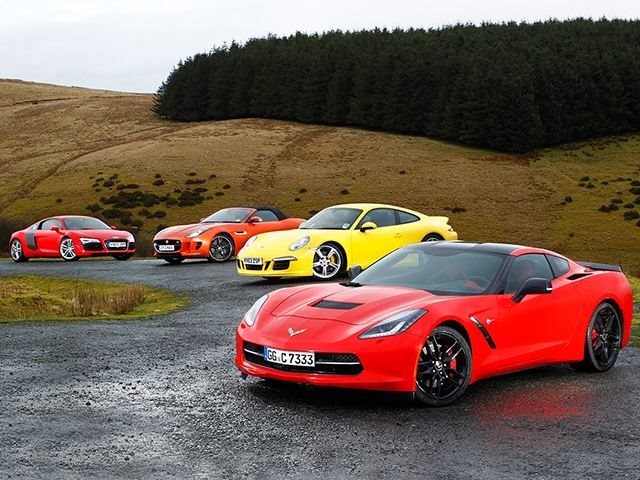
Most people would put American muscle cars and Germany’s luxury sports cars into two separate classes. Muscle cars are known for being cheap and featuring big V8s whereas Germany’s luxury sports cars are pricey and put handling over straight-line speed (though they were still plenty quick). But nowadays it seems like the two sets of cars are equal in all areas except price. Or are they? To find the answer we’ve turned to our own Gabriel Beita-Kiser (pro Germany) and Michael Hines (U-S-A, U-S-A) for help.

If you’re in the market for speed, why buy something fancy when it can go as fast as a car that costs half as much? This is a tough issue to flesh out when it comes down to raw performance numbers, but sit behind the wheel of a German sports car and an American muscle car and the differences in price become as clear as day. Just look at the Viper SRT and the Audi R8 V10. Okay so the Audi costs $105,000 more than the Dodge, but you're also getting a whole lot more car. If you need something to adorn your McMansion, go with the Viper, but if you actually want to drive, take the R8. Even though it weighs 360 pounds more than the Viper and has only 30 less horsepower, it accelerates faster.

From standstill, 60 mph comes 0.7 seconds quicker than in the Viper. And in the R8 you can manhandle corners. The Dodge requires a life insurance policy to even turn the wheel. These characteristics make speed more accessible and puts German sports cars in another league. Thank me later when you’re enjoying the scalpel-like precision of a Porsche 911 GTS and not spending time complaining about how the ZL1 Camaro sucks to drive around town. Speaking of the two, what does a $33,950 difference between the two cars get? The Porsche has 210 horsepower less than the Camaro, but it hits 60 mph from standstill 0.2 seconds quicker. The Porsche will also turn more heads, handle gloriously, and come with every electronic toy in the book.

This serves to make city driving pleasurable while also letting you crush all comers at the track. The truth is that, despite being fast, the selling points of most muscle cars are just cheap and gimmicky add-ons. Chevy makes a big deal about the aerodynamic "Flowtie" on the ZL1, but you could buy a Mercedes AMG GT with a real active wing and stop playing. Cheap American muscle tries to make up for the gap in quality with brute force, but it just feels wrong when even the carbon fiber looks like a pasted on afterthought. There's no problem with cutting costs and maintaining power to meet a budget, but for those with the cash, splurge and live without regret.

The automotive community is one of the most prejudiced groups of people on the planet. Gearheads routinely judge cars based on badges alone. Yes, automakers have established certain reputations over time, as have certain models. Seismic shifts in the industry happen all the time, yet people are slow to acknowledge them, if they do at all. One of these shifts is the closing of the gap between America’s best muscle cars and Germany’s luxury sport cars. In a recent episode of Motor Trend’s “Head 2 Head,” hosts Jason Cammisa and Jonny Lieberman both picked the new Camaro SS over the BMW M4. The Camaro’s 6.2-liter V8 is bigger and more powerful than the M4’s 3.0-liter twin-turbo inline-six at 455 hp and 455 lb-ft of torque vs. 425 hp and 406 lb-ft of torque.

The BMW weighs 184 pounds less, though. Both are beauties, and there’s only one major difference between them. As tested the M4 was $81,045 while the Camaro SS was $46,095. That’s $35,000 for a badge and bragging rights. Speaking of bragging rights, the Dodge Viper ACR, equipped with the optional Extreme Aero Package, ran a faster lap at Laguna Seca than the Porsche 918 Spyder. Price difference: around $1 million bucks. It’s very American to say “bigger is better.” But what about things that you can’t measure in numbers, like quality? That gap has closed too. The Corvette was best in its class (midsize premium sporty car) in J.D. Power and Associates 2015 Performance and Design Ratings & Awards.

It beat out the Porsche 911 and the Mercedes-Benz SL-Class. With the exception of the Challenger, today’s American muscle cars are leaner and more athletic than ever before. They're just better all around. Even the Germans have taken notice. There was that Corvette police car and that funny sales month in Germany (March 2016) when the Mustang beat out both the Audi TT and Porsche 911 (and Cayman/Boxster) to be the country’s top sports car. True, America still has a long way to go before its muscle cars will be as highly regarded as Germany’s sports cars. But the gap has shrunk drastically and in certain situations you could argue that it doesn’t exist at all…or that it’s flipped entirely.


View the original article here

2018 Acura MDX Review: Practical Luxury Value But Falling Behind The Competition

The MDX is a fine vehicle, but it feels out of date in a very competitive segment.

Acura is a brand caught between two worlds, its past and its present. Its past is an enthusiast’s dream of the Integra Type R, NSX and even the first TLX with its sweet, sweet manual transmission. Its present is that it has dwindled to a shadow of its former glory, selling luxury commuter appliances based on an excellent value proposition and sales dropping to a six-year low in 2017.

Aside from the NSX, which only sold 581 units anyway, every model in its lineup saw sales fall in 2017 compared to the previous year. Even its bread-and-butter SUVs, the RDX and MDX, dropped off slightly when SUV and luxury crossover sales are exploding. What to do, what to do? Well, for starters, Acura has just taken the wraps off a new generation of the RDX at the New York Auto Show, introducing an all-new interior theme and infotainment, instantly making the 2018 Acura MDX interior seem somewhat obsolete despite a relatively recent refresh (with yet another new grille and some equipment updates).

A hybrid was also added to the lineup, but apparently nobody cares because it hasn’t moved the needle sales wise, just over 1,800 finding homes in the US. Anyhow, let’s ignore the hybrid just like the rest of America, and focus on the standard V6 that you are likely interested in. The V6 is Honda’s go-to big gun, 3.5 liters and direct injected with variable timing, making 290 horsepower and 267 lb-ft of torque the old fashioned way at high revs. Peak torque arrives at 4,700 rpm and peak power at 6,200 rpm, which is pretty heady territory for an SUV these days.

In an era of turbo torque and boosted sixes, 290 horsepower doesn’t sound all that impressive for a large-ish midsize SUV, but the MDX keeps weight in check at 4,257 pounds when competitors like the X5 and GLE top 4,600 lb and the Q7 porker is almost pushing 5,000! One area where they probably save weight is sound insulation, because the MDX is not the quiet, serene cabin you might expect of a large luxury vehicle. Wind and road noise aren’t too intrusive, but the suspension tends to crash and clank over rough roads, even though it does the job of absorbing the impacts.

The engine isn’t the sweetest sounding V6 you ever heard, wheezing a bit as it’s pressed, not quite the throaty growl the Germans pull off, nor the screaming VTEC yowl of old Hondas. The MDX wins at efficiency though, rating a thrifty-for-its-size 26 mpg for highway driving, 19 in the city and 22 combined. In our week with it, we finished at 19.6 mpg at the tail end of winter, which for my driving habits and routine is quite good. Still, the power is there, and it gets up to highway speeds in about six seconds, and the new 9-speed transmission shifts quickly and unobtrusively.

While paddle shifters are standard, you won’t need them because the transmission does well enough when left alone, and the Dynamic Mode sharpens throttle and transmission response and firms up steering without being hyper. Regular comfort mode is just a bit too sloppy, especially the super light steering, so sport quickly became our default. Note that suspension will firm up in certain driving situations, but does not take on a firmer setting with the sport mode. It’s well tuned for everyday driving, but if you get a little too carried away believing the commercials hyping Super-Handling All-Wheel Drive (SH-AWD), you might be disappointed.

There’s a bit more body roll than I would expect of a premium, nominally sporty crossover. Although the wheels are 20-inches, they have generous sidewalls to take the sting out of impacts, but the winter tires outfitted on our tester gave up handling prowess for snow traction. It still has a nice balance to it, but overall it was disappointing dynamically, and much more of a high-riding, ho-hum family hauler than the surprising and athletic crossover it had been in earlier generations. In particular I remember my first drive in the second generation MDX, and the then-new SH-AWD just blew my mind and eclipsed the Germans for dynamics at the time.

These days, where it eclipses the Germans is value. Just as the Q7’s weight is staggering, so too is its price tag, with any Teutonic seven-seater a pricey proposition. The Acura MDX starts at $44,200 in base front-wheel drive trim with a $940 Destination charge, and there’s plenty of standard equipment, but at that price you should look long and hard at the CX-9 – it’s what the MDX used to be: dynamic, luxurious and great value. The MDX in $58,150 Advance trim we drove, however, is still practical and luxurious, especially with the Advance package, the Milano leather and Olive Ash wood trim offering a feeling of warmth in the high-tech cabin.

The two stacked screens take some getting used to, the top screen with navigation, audio and phone functions controlled by the large scroll knob, and the lower touchscreen controlling climate and also audio. It seems a bit confusing at first, and we didn’t like how the seat heater controls take two presses to activate, but you get used to it, and I, for one, appreciate how it helps declutter the center console. The transmission shifter is another feature that also takes some getting use to but frees up real estate for generous at-hand storage and a large armrest hiding a massive storage compartment.

Steering wheel controls also mean you can skip reaching over to the center stack for most things, and also houses the adaptive cruise, which has low-speed follow abilities. It is not the smoothest system among competitors, and the forward collision alert is a bit sensitive, but hey, better safe than sorry. In Advance trim, the second row goes from a bench for three to two captain’s chairs (making it a six-seater instead of the standard seven) that are heated, with a wood-trimmed console containing storage and cupholders, plus charging ports and rear temperature controls. And with the press of a button, the seat back flips forward and the seat slides forward to allow easy access to the third row.

One misstep however, is that the doors don’t open very wide, making getting in and out or child seat installation a bit more difficult – kids probably won’t notice, but older folks might. The third row is passable for this size vehicle, but not a place any adult would want to spend much time in. Finally, cargo space is modest at 15 cubic feet with all three rows up, 38.4 cu. ft. with the third row dropped, or 68.4 with all seats folded, which offers a nice, flat surface all the way to the front seats. However, the third row splits 50/50 and second row also splits and folds, so there are a variety for different layouts you can go with to carry awkwardly shaped cargo and passengers simultaneously.

Unfortunately for Acura, although the MDX is a good, safe SUV, and fairly safe bet for reliability and resale, it just seems incredibly dull compared to the competition. The X5 looks badass and drives like a champ; the GLE is a Mercedes, which everyone wants; the Porsche Cayenne is a Porsche that does Porsche-y things (and people will pay the steep premium for it, or buy the smaller Macan); the Lexus RX might not have the seven seats yet, but it is reliable, funky looking, and comes across as the better value; and no doubt the popularity of the stylish Volvo XC90 has been eating the MDX’s lunch. From the other end, Acura needs to watch out for Mazda’s CX-9, which in Signature trim is just as luxurious and drives better than the MDX.

Is the MDX suddenly a bad vehicle? Nope, there’s actually a lot going for it, and it may simply be a victim of its longevity – it’s just not the latest shiny new thing that people want, and as you can see from above, there are lots of shiny new things for people to pick from in this segment and price point.


View the original article here