Showing posts with label sports. Show all posts

Monday, June 3, 2019

Rising Porsche 911 Sales Prove That Sports Cars Are Far From Dead

Although the Macan and Cayenne did pretty well too.

Porsche is having a terrific sales year so far in 2018. Through the first half of the year, the company has delivered 130,598 cars globally. Not only is this a 3% increase compared to last year, it is the most successful first half in Porsche's history. The success comes from increasing sales of several popular models. The Panamera experienced the strongest growth with 20,500 units sold, nearly double the figure from the first half of 2017.

The Panamera's sales success is likely due to the introduction of a new generation and a fresh Sport Turismo variant. It isn't just the Panamera that was a volume seller, the 911 did pretty well too. Coming off its best sales year in the US in 2017, the 911 saw double-digit growth with a 28% increase in sales with 21,400 units so far in 2018. As automakers continue to tell us that SUVs are far more important than anything else, we can simply point to the 911 as a beacon of hope that sports cars can still be a growing segment. To put a damper on our argument, Porsche's SUVs did pretty well too.

Both Porsche SUV models outsold the 911, with the Macan continuing to be the company's best-selling vehicle. Porsche delivered 46,600 units of the Macan and 28,700 units of the Cayenne so far in 2018. We aren't saying that automakers shouldn't focus on developing popular SUVs, but clearly some attention can still go into sports cars.


View the original article here

Saturday, April 6, 2019

Rising Porsche 911 Sales Prove That Sports Cars Are Far From Dead

Although the Macan and Cayenne did pretty well too.

Porsche is having a terrific sales year so far in 2018. Through the first half of the year, the company has delivered 130,598 cars globally. Not only is this a 3% increase compared to last year, it is the most successful first half in Porsche's history. The success comes from increasing sales of several popular models. The Panamera experienced the strongest growth with 20,500 units sold, nearly double the figure from the first half of 2017.

The Panamera's sales success is likely due to the introduction of a new generation and a fresh Sport Turismo variant. It isn't just the Panamera that was a volume seller, the 911 did pretty well too. Coming off its best sales year in the US in 2017, the 911 saw double-digit growth with a 28% increase in sales with 21,400 units so far in 2018. As automakers continue to tell us that SUVs are far more important than anything else, we can simply point to the 911 as a beacon of hope that sports cars can still be a growing segment. To put a damper on our argument, Porsche's SUVs did pretty well too.

Both Porsche SUV models outsold the 911, with the Macan continuing to be the company's best-selling vehicle. Porsche delivered 46,600 units of the Macan and 28,700 units of the Cayenne so far in 2018. We aren't saying that automakers shouldn't focus on developing popular SUVs, but clearly some attention can still go into sports cars.

(function(w,d,s,l,i){w[l]=w[l]||[];w[l].push({'gtm.start':new Date().getTime(),event:'gtm.js'});var f=d.getElementsByTagName(s)[0],j=d.createElement(s),dl=l!='dataLayer'?'&l='+l:'';j.async=true;j.src='https://www.googletagmanager.com/gtm.js?id='+i+dl;f.parentNode.insertBefore(j,f);})(window,document,'script','dataLayer','GTM-MJCGS3N');var _comscore = _comscore || [];_comscore.push({ c1: "2", c2: "28140907" });(function() {var s = document.createElement("script"), el = document.getElementsByTagName("script")[0]; s.async = true;s.src = (document.location.protocol == "https:" ? "https://sb" : "http://b") + ".scorecardresearch.com/beacon.js";el.parentNode.insertBefore(s, el);})();

View the original article here

Wednesday, April 3, 2019

Here's How Porsche Is Celebrating 70 Years Of Sports Cars In Berlin

If you’re a fan of classic Porsches, you may want to make a trip to Berlin.

This year marks the 70th anniversary of Porsche’s first ever sports car, the iconic 356. Its landmark anniversary will be commemorated at this year’s Goodwood Festival of Speed, which will see a host of historic Porsche’s tackle the famous hillclimb. Of course, this won’t be the only celebration venue for such a significant birthday. Porsche has announced it will be opening a special "70 Years of Porsche Sports Cars" exhibition in its homeland of Germany.

The exhibition will be open from March 20 at the “Drive. Volkswagen Group Forum” Berlin, as this is where Porsche first received its permit to build the original 356. Best of all, admission is free of charge, so if you’re a fan of classic Porsches, you may want to make the trip. Chronicling Porsche’s extensive history, the exhibition is split across ten sections, including "Origin of the sports car," "Motorsport," and "Sports cars of the future.” Guests will be greeted by a Porsche 356 “No.1” Roadster show car representing the “Origin of the sports car” when they first enter, while Porsche’s first EV, the upcoming Mission E, will represent the brand’s future.

Other iconic cars on display for enthusiasts to drool over include the one-millionth 911 finished in Irish Green, the 917/20 “Pink Pig” Le Mans racer, and a new Panamera Turbo S E-Hybrid Sport Turismo. Porsche will be honoring some of its employees who helped shape the brand in the "70 Years of Passion" section, and fans will be able to take a virtual reality tour of the Panamera Turbo S E-Hybrid Sport Turismo. “The message of our exhibition is this: The spirit of innovation, which over 70 years has made Porsche into one of the world’s most profitable automotive manufacturer, will continue to drive a unique brand experience into the future,” said Achim Stejskal, Director of the Porsche Museum.


View the original article here

Saturday, March 30, 2019

Rising Porsche 911 Sales Prove That Sports Cars Are Far From Dead

Although the Macan and Cayenne did pretty well too.

Porsche is having a terrific sales year so far in 2018. Through the first half of the year, the company has delivered 130,598 cars globally. Not only is this a 3% increase compared to last year, it is the most successful first half in Porsche's history. The success comes from increasing sales of several popular models. The Panamera experienced the strongest growth with 20,500 units sold, nearly double the figure from the first half of 2017.

The Panamera's sales success is likely due to the introduction of a new generation and a fresh Sport Turismo variant. It isn't just the Panamera that was a volume seller, the 911 did pretty well too. Coming off its best sales year in the US in 2017, the 911 saw double-digit growth with a 28% increase in sales with 21,400 units so far in 2018. As automakers continue to tell us that SUVs are far more important than anything else, we can simply point to the 911 as a beacon of hope that sports cars can still be a growing segment. To put a damper on our argument, Porsche's SUVs did pretty well too.

Both Porsche SUV models outsold the 911, with the Macan continuing to be the company's best-selling vehicle. Porsche delivered 46,600 units of the Macan and 28,700 units of the Cayenne so far in 2018. We aren't saying that automakers shouldn't focus on developing popular SUVs, but clearly some attention can still go into sports cars.


View the original article here

Saturday, March 9, 2019

Legendary Le Mans Racer Inspires New French Sports Car

Built to celebrate company’s 50th anniversary.

Following teasers released a few months ago, long-forgotten French sports car maker Ligier has unveiled its latest model. Unveiled at the 2018 Paris Motor Show, the Ligier JS2 R celebrates the company’s 50th anniversary and is inspired by the Ligier JS2 that finished second at the 1975 Le Mans 24 Hours. “What better way to celebrate the 50th anniversary of the Ligier's brand than a new sports car?” said Jacques Nicolet, CEO of Ligier-Onroak Automotive.

“With its iconic livery, all is said. Ligier renews with the GT category. Remember, it was Guy Ligier's first love. In 1969, he had launched the Ligier JS1, the brand's first model, and in 1972, the Ligier JS2. We designed the Ligier JS2 R, a revival car, as a real racing car. A car to give maximum pleasure on the track, in races or on track days. Because this is what matters. I hope you will like it as much as we do.”

As you can already glean from the CEO’s comments, the Ligier JS2 R is not a series production car adapted for driving on a track, but a thoroughbred racer. Sadly, this means it isn’t street legal. The car it’s based on spawned a road-going version, but Ligier hasn’t announced plans to make a JS2 R road car.

Under the hood is a Ford-sourced 3.7 liter V6 engine that produces 330 horsepower. No performance specifications were provided, but the JS2 R weighs just 2,160 pounds so it should be capable of setting blistering lap times. It also has a 100-liter fuel tank, Brembo brakes, centrifugal clutch, adjustable dampers, paddle shifters, and a heated windshield.

Ligier says the JS2 R has been designed “to provide endless hours of pleasure behind the wheel” thanks to low running costs, long gaps between revisions and easy mechanical maintenance. It can be homologated in the FIA Free Formula Sports Cars (Group E) category and is equipped with cutting-edge safety equipment. Test days are scheduled for November 2018 in Europe before deliveries start in January 2019. The car will also compete in a one-make Ligier JS Cup racing series in France next year.


View the original article here

Tuesday, February 26, 2019

Ligier Has A New Road-Going Sports Car In The Works

Half a century of racing construction ought to make it pretty epic.

There's a new sports car coming. But it's coming neither from a new startup nor an automaker you may have heard of – unless you're a racing fan who knows his or her history.

Previewed in this teaser image is a new model being developed by Ligier. The French constructor has been around for 50 years now. And that's precisely the landmark anniversary which the as-yet-unnamed sports car seeks to celebrate. Though it's carved out a niche for itself making tiny city cars (primarily for the European market), most of Ligier's expertise has been in constructing race cars.

Based on what we can see so far, we're hopeful that the new sports car will draw more from its racing expertise than its city-car business. According to Motor1, the vehicle will pack a 3.7-liter V6 engine dispatching 330 horsepower through a six-speed, paddle-shift sequential gearbox.

Though we don't know for sure where Ligier will get the engine from, those specs are rather similar to the VQ engine in the Nissan 370Z. That may prove the smart bet, especially considering that Ligier's own JS P2 racing prototype is designed to use Nissan power.

The vehicle will reportedly carry an €89,000 starting price tag, putting it somewhere in between Porsche's 718 Cayman and 911. Word has it that it's also been designed for homologation under the FIA's E II SH regulations for silhouette racers, suggesting that a racing version will follow.

Ligier wouldn't be the first racing constructor to recently draw on its motorsport expertise to create a road car. Dallara recently rolled out the Stradale after 45 years of building race cars and helping other automakers (like Alfa Romeo, Renault, and KTM) develop their road cars. Here's hoping Ligier's will be nearly as awesome.


View the original article here

Sunday, December 23, 2018

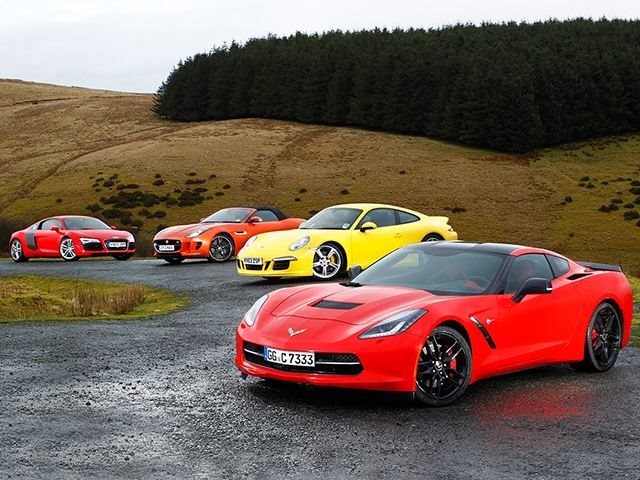
We Ask: Are Today's Top American Muscle Cars Better Than Germany's Luxury Sports Cars?

Try not to get too emotional.

Most people would put American muscle cars and Germany’s luxury sports cars into two separate classes. Muscle cars are known for being cheap and featuring big V8s whereas Germany’s luxury sports cars are pricey and put handling over straight-line speed (though they were still plenty quick). But nowadays it seems like the two sets of cars are equal in all areas except price. Or are they? To find the answer we’ve turned to our own Gabriel Beita-Kiser (pro Germany) and Michael Hines (U-S-A, U-S-A) for help.

If you’re in the market for speed, why buy something fancy when it can go as fast as a car that costs half as much? This is a tough issue to flesh out when it comes down to raw performance numbers, but sit behind the wheel of a German sports car and an American muscle car and the differences in price become as clear as day. Just look at the Viper SRT and the Audi R8 V10. Okay so the Audi costs $105,000 more than the Dodge, but you're also getting a whole lot more car. If you need something to adorn your McMansion, go with the Viper, but if you actually want to drive, take the R8. Even though it weighs 360 pounds more than the Viper and has only 30 less horsepower, it accelerates faster.

From standstill, 60 mph comes 0.7 seconds quicker than in the Viper. And in the R8 you can manhandle corners. The Dodge requires a life insurance policy to even turn the wheel. These characteristics make speed more accessible and puts German sports cars in another league. Thank me later when you’re enjoying the scalpel-like precision of a Porsche 911 GTS and not spending time complaining about how the ZL1 Camaro sucks to drive around town. Speaking of the two, what does a $33,950 difference between the two cars get? The Porsche has 210 horsepower less than the Camaro, but it hits 60 mph from standstill 0.2 seconds quicker. The Porsche will also turn more heads, handle gloriously, and come with every electronic toy in the book.

This serves to make city driving pleasurable while also letting you crush all comers at the track. The truth is that, despite being fast, the selling points of most muscle cars are just cheap and gimmicky add-ons. Chevy makes a big deal about the aerodynamic "Flowtie" on the ZL1, but you could buy a Mercedes AMG GT with a real active wing and stop playing. Cheap American muscle tries to make up for the gap in quality with brute force, but it just feels wrong when even the carbon fiber looks like a pasted on afterthought. There's no problem with cutting costs and maintaining power to meet a budget, but for those with the cash, splurge and live without regret.

The automotive community is one of the most prejudiced groups of people on the planet. Gearheads routinely judge cars based on badges alone. Yes, automakers have established certain reputations over time, as have certain models. Seismic shifts in the industry happen all the time, yet people are slow to acknowledge them, if they do at all. One of these shifts is the closing of the gap between America’s best muscle cars and Germany’s luxury sport cars. In a recent episode of Motor Trend’s “Head 2 Head,” hosts Jason Cammisa and Jonny Lieberman both picked the new Camaro SS over the BMW M4. The Camaro’s 6.2-liter V8 is bigger and more powerful than the M4’s 3.0-liter twin-turbo inline-six at 455 hp and 455 lb-ft of torque vs. 425 hp and 406 lb-ft of torque.

The BMW weighs 184 pounds less, though. Both are beauties, and there’s only one major difference between them. As tested the M4 was $81,045 while the Camaro SS was $46,095. That’s $35,000 for a badge and bragging rights. Speaking of bragging rights, the Dodge Viper ACR, equipped with the optional Extreme Aero Package, ran a faster lap at Laguna Seca than the Porsche 918 Spyder. Price difference: around $1 million bucks. It’s very American to say “bigger is better.” But what about things that you can’t measure in numbers, like quality? That gap has closed too. The Corvette was best in its class (midsize premium sporty car) in J.D. Power and Associates 2015 Performance and Design Ratings & Awards.

It beat out the Porsche 911 and the Mercedes-Benz SL-Class. With the exception of the Challenger, today’s American muscle cars are leaner and more athletic than ever before. They're just better all around. Even the Germans have taken notice. There was that Corvette police car and that funny sales month in Germany (March 2016) when the Mustang beat out both the Audi TT and Porsche 911 (and Cayman/Boxster) to be the country’s top sports car. True, America still has a long way to go before its muscle cars will be as highly regarded as Germany’s sports cars. But the gap has shrunk drastically and in certain situations you could argue that it doesn’t exist at all…or that it’s flipped entirely.


View the original article here