Showing posts with label todays. Show all posts

Saturday, June 1, 2019

The Best Porsche 911 In Today’s Lineup Will Return For The 992 Generation

And when we say 'best,' we mean the purist 911 for the money.

Porsche has become an expert in finding, developing, and ultimately building sought-after 911 variants. From the base 911 Carrera to the hardcore 911 GT2 RS, there’s literally a 911 for every budget north of the $90,000 entry price. We’re only a couple of months away from the official reveal of the next-generation 911, the 992, but Porsche is keeping its details a secret for now despite numerous spy shots and videos showing nearly camo-less 911 992s. But will Porsche continue with all of the outgoing 991’s trims or create new ones?

According to Road and Track, at least one recently launched 911 variant will return, the purist-focused 911 T. The publication spoke with 911 chief engineer August Achletiner at Porsche’ Rennsport Reunion last month and specifically asked him whether the 911 T will return.

“Absolutely,” he said. "In the last half-year, I almost only drove a Carrera T [with a] manual and I love this car," Achletiner added. "It's just pure. The only option I have beside the navigation system is a sunroof. Wonderful.” The Porsche 911 T still isn’t exactly cheap, beginning at around $100,000, but it is still a fair amount less than the GTS and GT3 Touring, for example. With its classic 911 styling, shorter gear ratios, and a more driver-focused chassis configuration, the 911 T quickly became a sales success, and it makes complete sense for Porsche to make this trim a permanent part of the future lineup. Another good sign for 911 purists is the fact that Achletiner is personally a huge fan of manual transmissions.

He told Road and Track that despite the PDK gearbox offering superior shift times, manuals are simply more fun. "I think the PDK from a technical point of view is a better solution, but it's just fun to operate the manual," he said. As long as Achletiner is running the show, it seems like the manual gearbox is safe in future 911s, despite the superiority the PDK offers. So, when exactly will the 992 generation 911 make its debut appearance? Soon, perhaps at the LA Auto Show late next month.


View the original article here

Wednesday, December 26, 2018

This Rare 1995 RUF 911 Is Nearly As Fast As Today's Supercars

But is it worth its crazy asking price?

Special edition versions of the Porsche 911 have become the envy of collectors, with insane price tags to match. There are many rare 911 models that have been built over the years, but some of the rarest and most impressive models come from German manufacturer RUF. The CTR Yellowbird was perhaps the most legendary car that RUF ever produced, so much so that the company is actually reproducing the car. The Yellowbird was certainly legendary, but its successor was also an extremely impressive car.

RUF burst onto the scene with the Yellowbird, which was based on a Carrera 3.2. In 1995, RUF needed to replace the CTR with a new model, which needed to be spectacular to live up to the legend of the Yellowbird. RUF called this new car the CTR2, and it was based on the 993 Turbo. The 993 generation is now one of the most popular 911 models on the market, and prices have clearly reflected that. Back in 1995, the CTR2 had an extremely high asking price of $315,000. This may not sound too bad by today's standards, but keep in mind that a V12 Lamborghini Diablo would have been around $230,000 back in 1995.

The CTR2 may have been expensive when new, but after seeing one for sale today, it's obvious that the car was a good investment. We found a 1995 CTR2 for sale at McLaren of Scottsdale for a whopping $799,000. This is one of the most expensive 911 models that we've seen in a while, but there are many reasons why this car demands such a big premium over a normal 993. For starters, this CTR2 is one of only 16 produced from 1995 to 1997. Power comes from a race-derived version of Porsche's air-cooled 3.6-liter twin-turbo flat-six, which was used in the Porsche 962 Le Mans Group C car. RUF tuned this engine to produce a massive 520 hp and 505 lb-ft of torque.

The CTR2 was available with either RWD or AWD and came with Recaro racing seats with five-point belts, enlarged brakes, roll-cage, RUF manufactured coil-over suspension, bi-functional rear wing, and a kevlar body with lightweight glass. Performance was off the charts at the time, and is still competitive with today's supercars. 0-60 mph took just 3.5 seconds and the top speed was around 220 mph. Only the McLaren F1 was able to best the CTR2's performance by 1998. In a 1997 issue of Road & Track, the CTR2 completed the quarter-mile in 11.4 seconds at 133.7 mph, which could easily keep up with today's sports cars.

This example has less than 26,000 miles on the odometer, and looks extremely fresh on the inside and out. It is not very often that a RUF comes up for sale in the US, so Porsche collectors should be quick to scoop this one up.


View the original article here

Sunday, December 23, 2018

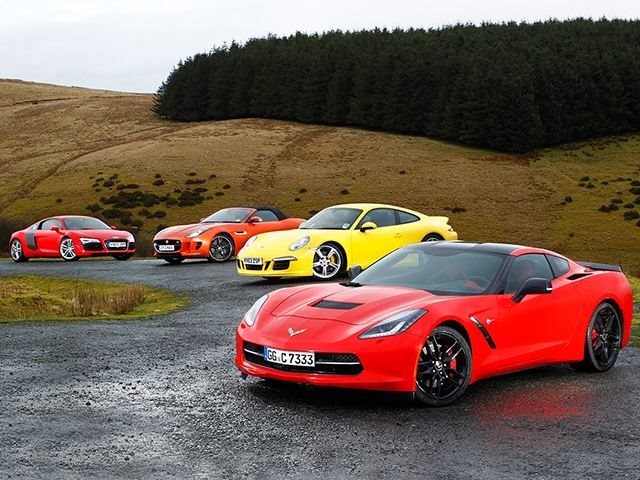
We Ask: Are Today's Top American Muscle Cars Better Than Germany's Luxury Sports Cars?

Try not to get too emotional.

Most people would put American muscle cars and Germany’s luxury sports cars into two separate classes. Muscle cars are known for being cheap and featuring big V8s whereas Germany’s luxury sports cars are pricey and put handling over straight-line speed (though they were still plenty quick). But nowadays it seems like the two sets of cars are equal in all areas except price. Or are they? To find the answer we’ve turned to our own Gabriel Beita-Kiser (pro Germany) and Michael Hines (U-S-A, U-S-A) for help.

If you’re in the market for speed, why buy something fancy when it can go as fast as a car that costs half as much? This is a tough issue to flesh out when it comes down to raw performance numbers, but sit behind the wheel of a German sports car and an American muscle car and the differences in price become as clear as day. Just look at the Viper SRT and the Audi R8 V10. Okay so the Audi costs $105,000 more than the Dodge, but you're also getting a whole lot more car. If you need something to adorn your McMansion, go with the Viper, but if you actually want to drive, take the R8. Even though it weighs 360 pounds more than the Viper and has only 30 less horsepower, it accelerates faster.

From standstill, 60 mph comes 0.7 seconds quicker than in the Viper. And in the R8 you can manhandle corners. The Dodge requires a life insurance policy to even turn the wheel. These characteristics make speed more accessible and puts German sports cars in another league. Thank me later when you’re enjoying the scalpel-like precision of a Porsche 911 GTS and not spending time complaining about how the ZL1 Camaro sucks to drive around town. Speaking of the two, what does a $33,950 difference between the two cars get? The Porsche has 210 horsepower less than the Camaro, but it hits 60 mph from standstill 0.2 seconds quicker. The Porsche will also turn more heads, handle gloriously, and come with every electronic toy in the book.

This serves to make city driving pleasurable while also letting you crush all comers at the track. The truth is that, despite being fast, the selling points of most muscle cars are just cheap and gimmicky add-ons. Chevy makes a big deal about the aerodynamic "Flowtie" on the ZL1, but you could buy a Mercedes AMG GT with a real active wing and stop playing. Cheap American muscle tries to make up for the gap in quality with brute force, but it just feels wrong when even the carbon fiber looks like a pasted on afterthought. There's no problem with cutting costs and maintaining power to meet a budget, but for those with the cash, splurge and live without regret.

The automotive community is one of the most prejudiced groups of people on the planet. Gearheads routinely judge cars based on badges alone. Yes, automakers have established certain reputations over time, as have certain models. Seismic shifts in the industry happen all the time, yet people are slow to acknowledge them, if they do at all. One of these shifts is the closing of the gap between America’s best muscle cars and Germany’s luxury sport cars. In a recent episode of Motor Trend’s “Head 2 Head,” hosts Jason Cammisa and Jonny Lieberman both picked the new Camaro SS over the BMW M4. The Camaro’s 6.2-liter V8 is bigger and more powerful than the M4’s 3.0-liter twin-turbo inline-six at 455 hp and 455 lb-ft of torque vs. 425 hp and 406 lb-ft of torque.

The BMW weighs 184 pounds less, though. Both are beauties, and there’s only one major difference between them. As tested the M4 was $81,045 while the Camaro SS was $46,095. That’s $35,000 for a badge and bragging rights. Speaking of bragging rights, the Dodge Viper ACR, equipped with the optional Extreme Aero Package, ran a faster lap at Laguna Seca than the Porsche 918 Spyder. Price difference: around $1 million bucks. It’s very American to say “bigger is better.” But what about things that you can’t measure in numbers, like quality? That gap has closed too. The Corvette was best in its class (midsize premium sporty car) in J.D. Power and Associates 2015 Performance and Design Ratings & Awards.

It beat out the Porsche 911 and the Mercedes-Benz SL-Class. With the exception of the Challenger, today’s American muscle cars are leaner and more athletic than ever before. They're just better all around. Even the Germans have taken notice. There was that Corvette police car and that funny sales month in Germany (March 2016) when the Mustang beat out both the Audi TT and Porsche 911 (and Cayman/Boxster) to be the country’s top sports car. True, America still has a long way to go before its muscle cars will be as highly regarded as Germany’s sports cars. But the gap has shrunk drastically and in certain situations you could argue that it doesn’t exist at all…or that it’s flipped entirely.


View the original article here